HEADQUARTERS ARTILLERY BRIGADE,
Jacksonville, Fla., March 25, 1864.
SIR: Pursuant to instructions, I have the honor to report the action of the
artillery under my command at the late battle of Olustee, Fla., February 20,
1864:
On the morning of February 20, General Seymour's command, of which my own was
a portion, left Barber's Ford, near Saint Mary's River, en route for
Lake City. My own immediate command consisted of my battery (M, First
Artillery
), four light 12-pounder brass guns, and a section of Captain James'
Third Rhode Island Volunteer Artillery, under Lieutenant Metcalf, in all six
guns. I was attached to Barton's brigade, and about the center of the column. As we neared Olustee, Barton having heard some firing in front, and noticing its increase, threw out a regiment on the left and two on the right. We then, after a short halt, moved on in three parallel lines, the regiment, by the flank and the battery in column of pieces. Quite or nearly an hour had been occupied by different halts, and not much ground gone over by us, who were not in advance. During all this the firing occurred with fewer intervals and more force after the first shots until we moved on the last time, when it had become a continuous but not very loud rattle of musketry. I was soon met by an aide, who brought orders for me to "come up at once," and a few minutes afterward I received another order to "come up as quickly as possible." I started out at a trot, leaving the infantry to which I was attached, and coming behind the line of battle near where Hamilton's caissons stood, and I think one of his sections not engaged. Here seeing the general in command, his staff, and Hamilton, the chief of artillery, I waited for further orders. After forming line, nearly perpendicularly to the line of battle, pieces in front and prepared to move in any direction, I waited there some five or ten minutes, when an aide came to me and said I was wanted, or help was wanted, on the left; in addition, as nearly as I can remember, he added, "We are threatened there ;" or, "We are threatened there and unsupported. Go on the left." Moving to the left then and some 150 yards to the rear of and obliquely to the line of battle, I was overtaken by another aide who told me "to send one section off to the right." I detached Lieut. Tully McCrea, whose section was the nearest, and asking the aide-de-camp to point out the way to McCrea, I moved on with the other four guns; this was done without halting, his section merely wheeling out of line. I saw McCrea no more until the line was ordered to retire. I came into battery by wheeling the sections to the right, having Metcalf's section on my left.
My position was about 100 or 150 yards to the left, and quite as much to the
rear of Elder's battery. The latter was the extreme left of the line then in
my front; at least, there was nothing that presented the appearance of a
regiment in line. I have been informed that the Seventh New Hampshire and the
Eighth U.S. Colored were posted on my left. I did see a crowd of men firing
wildly in my front, but without order or judgment. I saw what I believed to be
Elder's battery on my right and front, and on his right other guns and a line
of men, firm and cool, firing as if on parade, and out of this line men
dropping singly and in groups, wounded and dying. From my position not an
enemy could be seen, though the bahs came occasionally with such force as to
indicate their immediate vicinity. They must have fired from the grass and
trees. A line of smoke in front was my only guide. I fired a few rounds, but
was not satisfied, for I could see no result, as I was firing high to reach
their reserves. There being nothing visible in front, I limbered to the left
and moved farther to the left, about 100 yards. Here the same difficulties
presented them-selves--the trees too thick to obtain a chance to fire, and my
men and horses falling from an invisible foe. In my first position, before
firing at all, I lost 2 or 3 men, how badly hurt I do not know. In my second
position I had but a few minutes to wait before the enemy seemed to have
suddenly discovered me, for the balls came now rapidly and evidently directed
at us, and though I fired double canister, in fact, everything I could get
at, the men and horses went down fast. My men acted as well as men could; and
now occurred an incident which, for my two guns, materially changed the face
of affairs. A caisson of my battery, through the stupidity of the drivers or
fright of the horses, passed the guns and wheeled to the left, directly
between me and the enemy. Out of the 18 men who should have been with the guns
I had about 8 left. The drivers of the caisson, becoming an immediate target
for the enemy, soon left the horses. They were sent back, and 2 retreated. One
remained and succeeded in starting the caisson, but it got fastened by a tree,
and the man came back, stating it was impossible to get it out alone. There
was no one to help him, and the caisson was left, but at that instant the
leaders broke away and came among us. Metcalf had meanwhile limbered up and
moved to the rear: this was without orders from me. I learned afterward that
Elder, seeing what he then thought my dangerous position, had advised him to
leave. My position I now realized was serious; the caisson that prevented my
firing directly to the front, and which had oc-casioned so much trouble, was
abandoned, and orders given to "limber up." One limber now got caught in a
tree, a horse went down and was ordered to be cut out; then another was
struck, then 2 drivers, 1 helping while he was bleeding to death. It was then
I looked back to my left and saw a cavalry force marching toward our rear. At
first I thought it was a portion of the Fortieth Massachusetts retiring from
the left and front, but seeing a company of Stevens' cavalry moving from the
real' toward them with sabers drawn, I turned a gun on the advancing enemy,
and Metcalf from the rear did the same. This was the first fair shooting I had
had as yet. They broke; at all events disappeared. Just at that moment a
sudden and alarming increase of the firing, culminating apparently in one
point, near where Hamilton and McCrea were on my right, attracted my
attention. The musketry firing had now increased to one loud, continuous peal,
amid which was heard the rapid cracking of the guns. But this roar and this
cannonade, as I said, all at once increased, and suddenly at one point. I saw
in this an advance of the enemy--a rush to break our center; and though, on
account of the smoke, the trees, and the leaves, I could see no foe, I turned
my two guns to the right and fired as rapidly as possible obliquely across and
in front of our forces, particularly the battery nearest me. All thought of
limbering up was now abandoned. I felt that the whole energies of the command
was directed to repel that one blow. The firing now reached its height, and
our men, firm and collected, we could see filling up the gaps. The enemy was
checked. I felt that if I had withdrawn the guns at that instant that the
infantry on my right would fall back with them, and in this firmness and this
obstinacy I felt reassured that I would find time to get some of my people,
who had been sent to the rear with the caissons, to come to my aid with the
limbers of the latter, and continue the firing or help off the guns. I had now
about 7 men untouched. The next thought was to get to the general, who, at
that instant, I saw near me, and report. The balls now coming so fast and the
men being struck every instant, I reluctantly gave the order to retire and
reported to the general. I asked for men and was answered that I could not
have them; all were engaged. I had no thought but that the ground would be
reoccupied in a few minutes, when with fresh men I would regain my pieces. The
line commenced retiring in good order, just after I spoke to the general,
and then I met one of McCrea's guns coming off, with some men carrying him,
wounded in both legs. He, too, had lost a gun, and himself and others were
wounded in attempting to get it off. As regards my support there was no
appearance of an organization of our people on my left or immediate front. I
saw a number of men of colored regiments in groups of from 2 up to 10, very
much excited and huddling behind my caissons, and some of them firing through
and over the battery. I saw 2 officers with them, but only for an instant. One
of them tried to wave them on with his sword; 5 or 6 followed him about ten
steps and then all retreated. The color bearer, a large, powerful man, with a
blue regimental flag, remained on the left of my guns, where Metcalf had been,
and near my piece; he stood there manfully and bravely to the last, and with
but 2 or 3 companions, sometimes entirely alone: what became of him I am
unable to say. I saw many wounded colored soldiers appearing suddenly in front
and on my left, without muskets, and it appeared as if they had been lying
down and taken the first opportunity to get to the rear. Some of the infantry,
while facing the enemy and firing wildly, did not show fear, nor did I see any
of them absolutely run off, but groups of them huddled together and did
nothing, and many were in this position shot, while they seemed unconscious
that they were hit. I desired them to take to the trees with a hope that I
would thus in a measure draw off the fire of the enemy. It is my impression
that this portion of the regiment had been broken, and retreated from the
front before I came up, and the appearance of my caissons reassured them and
brought them again up to the flag. At the time I drew off, and when I could
fire no longer, I saw a large body of the enemy in front advancing slowly and
waving their hats and shouting. They halted, apparently, but did not charge
the guns. This was the Nineteenth and Twenty-eighth Georgia, as stated by
their own papers. They contented themselves with shooting at a distance every
man who appeared near the guns.
I take this occasion--and it is one of the redeeming features of the whole
affair--to speak of the good conduct of First Sergeant Bach, Sergeant Lane,
and particularly of Sergeant Sweetman (badly wounded), Corporal McChesney
(wounded) and Corporals Kinsman and Delany. I cannot mention all the privates
engaged, but I have no reason to believe that any one of them acted otherwise
than well.
I lost 28 horses killed, principally at the pieces, 11 wounded, and 11 men
killed on the field, and 23 wounded, besides Lieut. Tully McCrea, of whose
gallantry the general was a nearer witness than myself.
I would take this occasion to recommend to the favorable notice of the
general, Dr. J. H. Janeway, whose ambulance was twice removed to the rear to
get it out of fire. He took charge of the whole artillery wounded, and putting
the two ambulances together, and assisted by his junior. Assistant Surgeon
Hillary, he was assiduous in his duties. To his watchful care we owe much in
the safety of the wounded officers, and on his arrival at Jacksonville he
quickly established a hospital, and thus collected and cared for the wounded
that he had not dispatched to Hilton Head.
That I unavoidably lost my guns, and that the enemy estimate their capture as
being greater than that of a regiment, is my only excuse for the length of
this report. Had I had a victory to record a few lines would have been
sufficient, but when one is unfortunate his report becomes an explanation.
I inclose Lieutenant Metcalf's report to me. I lost 3 guns of my 4, 2
caissons, and 2 limbers.
Respectfully submitted.
L. L. LANGDON,
Captain, First Artillery, Commanding Battery M.
Lieut. R. M. HALL,
Acting Assistant Adjutant-General.
Letters from Captain Langdon after the battle
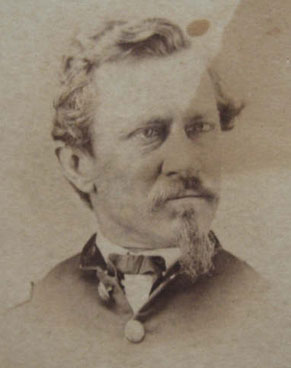
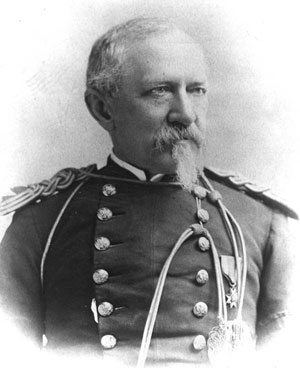
Editor's Note: Captain Loomis L. Langdon fought against the Seminole Indians before the Civil War. During the War he made sketches and subsequently studied painting at the National Portrait Gallery in London, England. However, he also stayed in the U.S. Army after the War and rose to high rank.
Other Reports from Olustee
Battle of Olustee Home Page
http://battleofolustee.org/