 |
 Western Reserve Historical Society |
|
Western Reserve Historical Society |
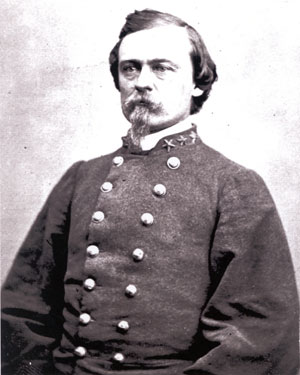
Opposing Seymour's force was a Confederate army under the command of Brigadier General Joseph Finegan, a forty-nine year old native of Clones, Ireland. A well-known planter, lumberman, and railroad operator in Florida before the war, Finegan had attended the secession convention as a delegate from Nassau County. His political connections within the state helped him secure the three stars and wreath of a brigadier general, and, in April 1862, he assumed command of the District of Middle and East Florida. In November 1862, the district was divided, with Finegan maintaining control over the eastern portion of the state. Finegan's command included all of Florida east of the Suwannee River, a large land area that, unfortunately, had few troops for defense. For the next two years he retained Confederate control over most of the state, notwithstanding occasional Union raids and skirmishes, and the annual Union occupation and 1983 burning of Jacksonville.
With his limited combat experience, Finegan was not highly regarded by either Florida Governor John Milton or General P.G.T. Beauregard, who commanded the Department of South Carolina, Georgia and Florida. Each would have preferred a more seasoned officer, but before a replacement could reach Florida, Seymour's advance precipitated a confrontation, and Finegan found himself facing the first major action of his military career.
At the time of the Federal invasion, Confederate troops in all of middle and east Florida combined numbered less than 3,000 effectives, with only 1,500 of this total present in the District of East Florida. Further complicating the Confederates' plight was the fact that virtually all of these troops were untest militia, who could not be expected to resist the Union advance without significant reinforcements.
General Beauregard responded to the crisis by significantly increasing Finegan's strength. As soon as word reached Beauregard of the embarkation of Union troops at Hilton Head, reinforcements were sent to Florida from locations in Georgia and South Carolina. Additional troops arrived from positions throughout Florida. These transfers were complicated by the lack of a connecting line between the railroads of Florida and the remainder of the Confederacy, forcing units to make long, fatiguing marches.
Despite these obstacles, by 19 February 1864, Finegan had accumulated between 5,000 and 5,500 men to defend the state. He organized his force into two brigades, under the commands of Brigadier General Alfred Colquitt and Colonel George Harrison. Both brigades had a mix of Florida and Georgia troops. In addition, Colonel Caraway Smith commanded the cavalry, and Captain Robert Gamble's Leon Light Artillery was held in reserve.
Brigadier General Finegan:
Reports prior to the battle, 13 February 1864
Files initial report of the battle, 23 February 1864
Replies to BGen Seymour's letter, 23 February 1864
Reports on actions after the battle, 25 February 1864
Issues final report of the battle, 26 February 1864
Photograph of Major Wilkinson Call, A.A.G., Finegan's staff
External Web sites related to the Battle of Olustee
Wikipedia page on General Finegan
Battle of Olustee home page
http://battleofolustee.org/