Final Report of Brigadier General Joseph
Finegan,
commanding Confederate Forces,
final report on the
engagement at Olustee
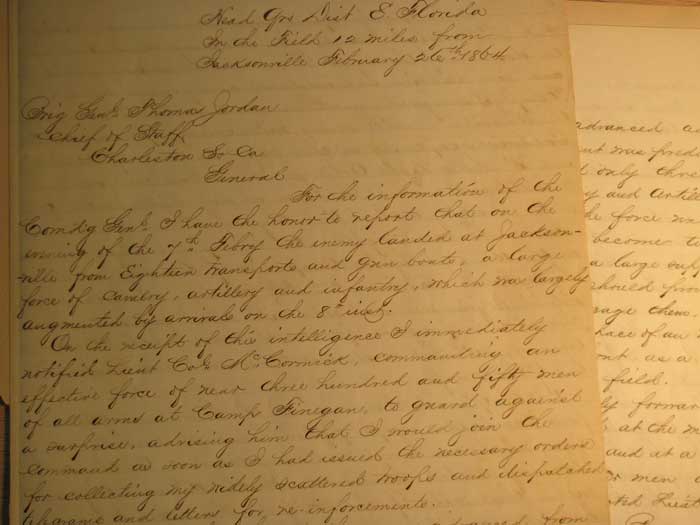
HEADQUARTERS DISTRICT OF EAST FLORIDA,
In the Field, 12 miles from Jacksonville, February 26, 1864.
GENERAL: For the information of the commanding general I have the honor to report that on the evening of February 7 the enemy landed at Jacksonville, from eighteen transports and gun-boats, a large force of cavalry, artillery, and infantry, which was largely augmented by arrivals on the 8th instant. On the receipt of this intelligence I immediately notified Lieutenant-Colonel McCormick, commanding an effective force of near 350 men, of all arms, at Camp Finegan, to guard against a surprise, advising him that I would join the command as soon as I had issued the necessary orders for collecting my widely scattered troops and dispatched telegrams and letters for re-enforcements.
On the night of the 8th instant, the enemy advanced from Jacksonville with great rapidity in three heavy columns, cavalry in the advance, artillery and infantry following, under command of Brigadier-General Seymour. They approached Camp Finegan as the command there were in the act of retiring. Their largely superior numbers deterred Lieutenant-Colonel McCormick, commanding, from attacking them, and in the darkness of the night he withdrew his command with caution and address and joined me at Camp Beauregard, near Ocean Pond, on the Olustee, on the 13th instant. The enemy with celerity pressed on to Baldwin, capturing on their way 5 guns of Companies A and B, Milton Light Artillery, which had been ordered to Baldwin. Reached Baldwin at daylight on the 9th instant. Remaining a short time, they continued on to Barber's the same night. At this point they were met on the 10th instant by two companies of cavalry under Maj. Robert Harrison, Second Florida Cavalry , whom I had ordered to join me, and who, with much gallantry, checked their progress for several hours at the Saint Mary's Crossing, with but small loss to us and a considerable loss to the enemy.
On the 9th instant, I removed all the Government stores from Sanderson, except 1,500 bushels corn, which was burned under my orders.
On the 10th, the enemy reached Sanderson. On the 11th instant, they were within 3 miles of Lake City. Here I had hastily collected, principally from the District of Middle Florida, a small force of 490 infantry, 110 cavalry, and two pieces of artillery. On the night of the 10th, I placed this force in a favorable position, 2 1/2 miles from Lake City, in the direction of the enemy. At 9.30 the enemy advanced upon us with a force estimated to be 1,400 mounted infantry and five pieces of artillery. Here they opened upon us, fighting as infantry, and skirmished heavily with my advance line. Discovering my position and its strength, and probably presuming my force larger than it was, they retreated to Sanderson, thence to Barber's, on the east bank of the Saint Mary's, where they constructed field-works and concentrated their whole force for a final movement on Lake City.
In the mean time I used every possible effort to gather re-enforcements, and on the 13th, moved to Ocean Pond, on Olustee, 13 miles from Lake City, and occupied the only strong position between Lake City and Barber's. Here I had field-works thrown up, and for several days, with a force less than 2,000 strong, awaited the enemy's advance.
In this time my command was increased by the arrival of re-en-forcements, and I organized the command as follows: The Sixth, Nineteenth, Twenty-third, Twenty-seventh, and Twenty-eighth Georgia Regiments Infantry and Sixth
Florida Battalion Infantry , as the First Brigade, under the command of Brigadier-General Colquitt, with the Chatham Artillery (four guns) attached. The Thirty-second Georgia Volunteers, First Georgia Regulars, Sixty-fourth
Georgia Volunteers , First Florida Battalion, and Bonaud's battalion, as the Second Brigade, under command of Col. George P. Harrison, Thirty-second Georgia Volunteers, with Guerard's light battery attached, the Florida Light Artillery being held in reserve. I assigned Col. R. B. Thomas, C. S. Army, to duty as chief of artillery, and organized the cavalry into a brigade, under the command of Col. Caraway Smith, Second Florida Cavalry, my whole effective force being as follows: Infantry, 4,600; cavalry, less than 600; artillery, 3 batteries--twelve guns.
On the 20th instant, the enemy advanced in three columns, since ascertained
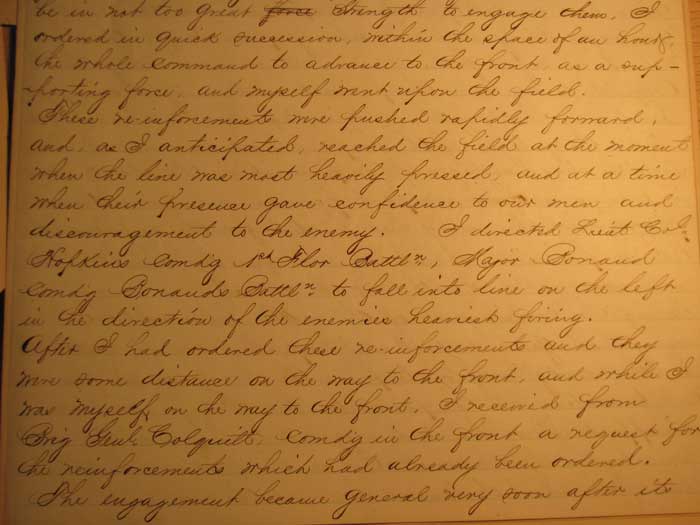
to have been twelve regiments of infantry (nine of white troops and three of black), estimated at 8,000, and some artillery (number of guns unknown), and 1,400 cavalry. At 12 m., the enemy were within 3 miles of my position. I ordered the cavalry, under Col. C. Smith, Second Florida Cavalry, supported by the Sixty-fourth Georgia, Colonel Evans commanding, and two companies of the Thirty-second Georgia, to advance and skirmish with the enemy and draw them to our works. The remaining force was placed under arms and prepared for action. Apprehending that the enemy was too cautious to approach our works, I ordered Brigadier-General Colquitt, commanding First Brigade, to advance with three of his regiments and a section of Gamble's artillery, and assume command of the entire force then ordered to the front and feel the enemy by skirmishing, and if he was not in too heavy force to press him heavily. I had previously instructed Colonel Smith, commanding cavalry, to fall back as our infantry advanced and protect their flanks. This movement was predicated on the information that the enemy had only three regiments of infantry, with some cavalry and artillery. Perceiving that in this movement the force under Brigadier-General Colquitt's command might become too heavily engaged to withdraw without a large supporting force, and intending that if
the enemy should prove to be in not too great strength to engage them, I ordered in quick succession, within the space of an hour, the whole command to advance to the front as a supporting force, and myself went upon the field. These re-enforcements were pushed rapidly forward, and, as I anticipated, reached the field at the moment when the line was most heavily pressed, and at a time when their presence gave confidence to our men and discouragement to the enemy.
I directed Lieutenant-Colonel Hopkins, commanding First Florida Battalion, and Major Bonaud, commanding Bonaud's battalion, to fall into line on the left in the direction of the enemy's heaviest firing. After I had ordered these re-enforcements, and they were some distance on the way to the front, and while I was myself on the way to the front, I received from Brigadier-General Colquitt, commanding in the front, a request for the re-enforcements which had already been ordered.
The engagement became general very soon after its commencement. The enemy were found in heavy force, their infantry drawn up in three supporting lines, their artillery in position, cavalry on their flanks and rear. I ordered Brigadier-General Colquitt to press them with vigor, which he did with much judgment and gallantry. They contested the ground stubbornly, and the battle lasted for four and a half hours. At the end of this time, the enemy's lines having been broken and reformed several times, and two fine Napoleon and three 10-pounder Parrott guns and one set of colors captured from them, they gave way entirely, and were closely pressed for 3 miles until night-fall. I directed Brigadier-General Colquitt to continue the pursuit, intending to occupy Sanderson that night; but in deference to his suggestion of the fatigue
of the troops, the absence of rations, and the disadvantages of the pursuit in the dark, and in consequence of a report from an advanced cavalry picket that the enemy had halted for the night and taken a position (which was subsequently ascertained to be incorrect), I withdrew the order. During the continuance of the battle, also after the enemy had given way, I sent repeated orders to Colonel Smith, commanding cavalry, to press the enemy on his flanks and to continue in the pursuit. But through some misapprehension these orders failed to be executed by him, and only two small companies on the left, and these but for a short distance, followed the enemy.
The enemy retreated that night, hastily and in some confusion, to Sanderson,
leaving a large number of their killed and wounded in our possession on the field. Their loss in killed, both officers and men, was large. Four hundred and eighteen of their wounded were removed by us from the field, and 400, or near that number, of their killed were buried by us; also nearly 200 prisoners were captured; several officers of high rank were killed and others severely wounded. Their loss cannot be less than 2,000 or 2,500 men, 5 superior guns, I set of colors captured, and 1,600 stand of arms; also 130,000 rounds cartridges (damaged by having been thrown into water), as appears by the report of the ordnance officer, herewith inclosed.
The victory was complete and the enemy retired in rapid retreat, evacuating in quick succession Barber's and Baldwin, and falling back on Jacksonville. The enemy's forces were under command of Brig. Gen. T. Seymour, who was present on the field.
The conduct of Brigadier-General Colquitt entitles him to high commendation.
He exhibited ability in the formation of his line and gallantry in his advance on the enemy. I have also to speak most favorably of Col. George P. Harrison , commanding Second Brigade, who exhibited in the engagement all the qualities of a capable and efficient officer. Col. R. B. Thomas, as chief of artillery, likewise rendered efficient service on the field. Colonel Evans,
commanding Sixty- fourth Georgia Volunteers , and Col. Duncan L. Clinch,
commanding Fourth Georgia Cavalry , were wounded while bravely performing their duty. Lieutenant-Colonel Barrow, Sixty-fourth Georgia Volunteers, and Captain Cannon, commanding, and Lieutenant Dancy, of the First Georgia Regulars; also Lieutenant Holland, commanding detachment from conscript camp, all officers of high promise, were killed.
Among the killed and wounded were many other officers and men who had distinguished themselves on other fields, for a detailed statement of whom, and for instances of individual merit, I refer to the reports of the brigade commanders. Our loss in the engagement was 93 killed and 841 wounded, a large proportion very slightly.
In the opening of the engagement the cavalry, under command of Colonel Smith, skirmished with the enemy with spirit and retired to the flanks in obedience to their orders.
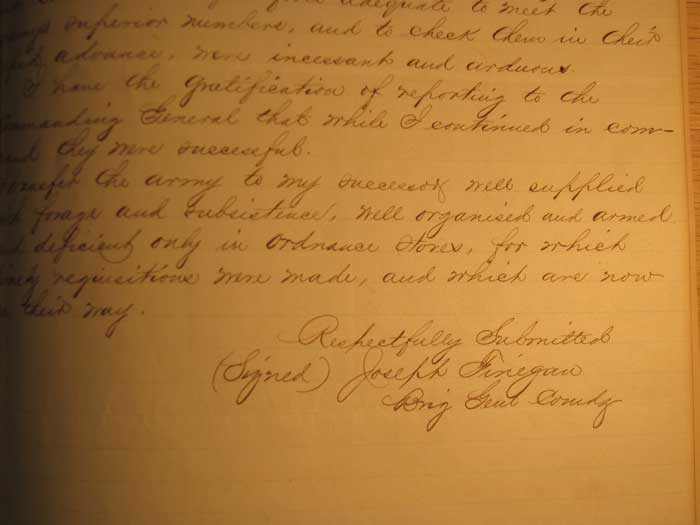
On the 22d instant, having repaired the railroad so as to secure my supplies, I advanced the command to Sanderson, pushing the cavalry rapidly in the direction of the enemy, and from Sanderson to Barber's, and thence to Baldwin and to this place, 12 miles from Jacksonville, where my further progress was arrested by orders from Brigadier-General Gardner, who had been directed to assume command, by whom I was here for the first time officially notified that the command had been transferred. My efforts and those of my officers for the organization and concentration of a force adequate to meet the enemy's superior numbers, and to check them in their rapid advance, were incessant and arduous. I have the gratification of reporting to the commanding general that while I continued in command they were successful. I transfer the army to my successor well supplied with forage and subsistence, well organized and armed, and deficient only in ordnance stores, for which timely requisitions were made, and which are now on their way.
Respectfully submitted.
JOSEPH FINEGAN,
Brigadier-General, Commanding.
Brig. Gen. THOMAS JORDAN,
Chief of Staff, Charleston, S.C.
Copied from The Official Records of the War of Rebellion.
General Finegan's copy of his February 26, 1864 report on the Battle Of Olustee
Other Reports from Olustee
Battle of Olustee home page
http://battleofolustee.org/